Optional callout banner for highlighted news or events

Learn More
Contact Us

Safe, Scalable, and Reproducible Aseptic Manufacturing of a Complex Long-Acting Injectable

Overview

Late-Stage Development of a Potent, High-Viscosity Formulation

A biopharmaceutical company developing a long-acting injectable formulation (LAIF) faced a triple threat: a highly potent API (HPAPI), an extremely viscous formulation, and an aggressive solvent that posed compatibility risks.

As the program advanced toward Phase 3, the team needed a manufacturing partner capable of producing this technically demanding formulation at scale, safely and consistently.

Pii met the challenge with a custom-engineered HPAPI containment isolator to ensure operator safety and product integrity, an in-house manufactured filter housing designed to maintain even flow of the viscous solution, and an extensive evaluation of material compatibility to safeguard against solvent degradation.

The result: GMP clinical batches delivered on time and in full—each meeting every critical quality attribute (CQA), positioning the prostate cancer program for a confident transition into pivotal trials.
2

custom systems engineered

Through in-house design and engineering of a custom containment isolator and nitrogen pressure-assisted filter housing, Pii delivered safe, consistent manufacturing of a complex LAIF that few CDMOs could handle.
CHALLENGE

Managing Potency, Viscosity, and Solvent Compatibility Challenges

This late-phase development program posed a complex combination of risks to operator safety, process design, and product consistency.

HPAPI Containment

Managing a highly potent peptide API introduced critical containment challenges. Protecting operators and preventing cross-contamination were non-negotiable, requiring specialized containment suites and strict cleaning protocols. Achieving this level of control at scale pushed standard systems beyond their design limits, and any delay in establishing effective containment risked halting production and postponing clinical progress.

Solvent Compatibility

The use of N-Methyl-2-pyrrolidone (NMP)—a highly polar, aprotic solvent—posed a major challenge to process design. Its tendency to interact with common polymeric and elastomeric materials meant that every contact surface, from filters to tubing and pre-filled syringe (PFS) seals, required scrutiny. Any oversight of even trace-level incompatibilities risked contamination, material degradation, and product instability.

Viscosity and Fill-Finish

The formulation’s viscosity exceeded the limits of standard pumps and filtration systems, making it difficult to achieve uniform flow and precise filling. Maintaining aseptic control added another layer of complexity to process design, and without modified equipment, the risk of incomplete filtration or inconsistent syringe fills threatened both product quality and clinical supply continuity.

Process Consistency

Unexpected assay variability complicated early process development, introducing uncertainty into process performance and hindering optimization. The lack of analytical consistency made it difficult to define process parameters with confidence, raising concerns about reproducibility and long-term manufacturing control. Without resolution, scale-up and GMP readiness would remain at risk.
SOLUTION

A Process Tailored to the LAIF’s Unique Manufacturing Requirements

Pii addressed each challenge through a combination of engineering innovation, material science, and process refinement. The team’s approach prioritized containment, control, and consistency, designing custom systems and workflows to ensure safe, reproducible, and GMP-compliant manufacturing.
Engineering Containment to Protect Operators and Product Integrity

With decades of experience handling potent compounds, Pii’s HPAPI team brings deep expertise in designing containment strategies that safeguard both personnel and product.
Drawing on this expertise, the team designed and built a fully enclosed containment isolator integrated directly with the compounding mixer for bulk drug preparation. This custom configuration enabled precise, closed-system processing with assured aseptic control.

Building an NMP-Compatible Process to Maintain Product Integrity

Pii conducted a comprehensive compatibility assessment to qualify all plastic and rubber process materials for use with NMP. Each component, including filters, tubing, gaskets, and PFS parts, was stress-tested under representative conditions to ensure long-term stability and control of potential extractables and leachables, resulting in an NMP-compatible process that safeguarded product purity.

Manufacturing a Custom Filtration Setup to Manage Extreme Viscosity

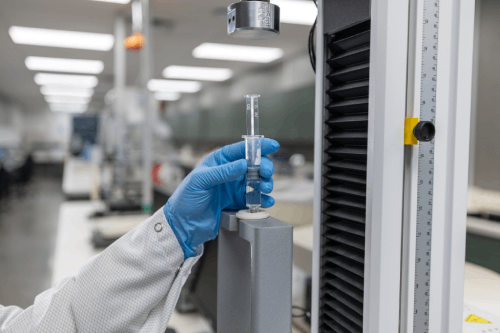
The formulation’s viscosity required a practical engineering solution to maintain flow control during filtration and filling. Pii designed and built a nitrogen pressure-assisted filter housing that provided a steady and uniform transfer of the formulation while maintaining sterility. They then filled PFSs using client-provided manual filling equipment specifically adapted to handle viscous formulations.
These purpose-built systems supported a reproducible process that scaled smoothly to clinical production.

Resolving Variability to Establish a Reproducible Manufacturing Process

The development team launched a structured root cause investigation to resolve assay variability, combining analytical troubleshooting with process mapping to rule out potential contributors systematically. This approach identified subtle factors affecting reproducibility, enabling targeted process refinements to resolve the discrepancies and establish a reproducible manufacturing process.

Inject Confidence Into Your LAIF Strategy

Late-stage success starts with early-stage strategy. Learn how modeling, material selection, and regulatory foresight can reduce risk in LAIF development.
Download Now
OUTCOMES

Clinical Batches Delivered under GMP Conditions, On Time and In Full

Pii successfully manufactured GMP-compliant clinical batches that met all CQAs, including assay, sterility, and particulate matter requirements:

  • Custom containment systems maintained operator safety and aseptic integrity
  • Qualified materials proved stable in contact with NMP, protecting product purity
  • Purpose-built filtration and filling setup enabled uniform filling of syringes
  • Process refinements resolved assay variability and ensured batch consistency
With a stable and validated manufacturing process in place, the biopharmaceutical company could proceed confidently toward Phase 3 clinical trials.

CONCLUSION

Solving Complex Manufacturing Challenges Through Custom Solutions

With a site purpose-built for complexity and a cross-functional team of over 300 specialists, Pii brings the infrastructure and practical problem-solving necessary for LAIF manufacturing. This foundation enabled the team to establish a robust aseptic manufacturing process ready to support clinical and commercial production.

Discover how Pii can solve your next complex manufacturing challenge

Explore Our Aseptic Capabilities
crossmenu